Quick answer: A small portable inverter generator can support a CPAP during a long outage, but it is usually a poor bedside or overnight power source. The safer, quieter plan is to run the CPAP from a compatible battery or portable power station near the sleeper, then operate the fuel-burning generator outdoors during waking hours to recharge that battery and power other essentials. For the generator itself, a 1,800-running-watt class model is already far larger than a CPAP alone requires; choose its size from the battery charger and every other load you plan to run.
Do not run a generator beside a tent, RV, window, door, vent, garage, or sleeping area. The U.S. Consumer Product Safety Commission says portable generators belong outdoors, at least 20 feet from homes and other buildings, with exhaust directed away from openings. A CO shutoff sensor is only an extra layer of protection; it does not make indoor or close-to-building operation safe.
Affiliate disclosure: Generator Square may earn a commission from qualifying Amazon purchases through links on this page, at no additional cost to you. Product details are based on current manufacturer and retailer data; we do not claim hands-on testing. Verify the current listing and manuals before purchase.
Medical-use note: Your exact CPAP manual and equipment provider should control the backup-power plan. Do not change prescribed pressure, stop therapy, or disable prescribed comfort features simply to reduce power use without appropriate guidance. If your condition or equipment requires uninterrupted support, ask your clinician or equipment provider for a documented outage plan.
The best CPAP backup is a layered power plan
A fuel generator makes noise, creates carbon monoxide, needs periodic refueling, and should not be left running near a sleeper. A compatible battery or power station is silent at the point of use and does not produce exhaust. Combining the two tools separates overnight therapy from generator runtime: charge the battery outside-generator-to-inside-battery during the day, shut the generator down safely, and use stored energy overnight.
| Layer | Job | What to verify |
|---|---|---|
| Bedside battery or power station | Runs the CPAP quietly while you sleep | CPAP compatibility, usable watt-hours, approved cable or adapter, and runtime with your settings |
| Portable inverter generator | Recharges the battery outdoors and carries selected daytime loads | Charger input watts, total loads, outlet ratings, fuel, noise rules, and safe placement |
| Fallback plan | Covers a failed start, depleted fuel, or bad weather | Second charged battery, alternate location with power, and provider instructions |
This arrangement is not a seamless uninterruptible power supply. Many CPAP machines stop when AC power disappears, and some battery arrangements require manual reconnection. Test the exact transition while awake, following both manuals. If automatic switchover is important, confirm that capability in writing rather than assuming any power station provides it.
How much power does a CPAP use?
There is no trustworthy universal watt figure. Device model, pressure, leaks, altitude, heated humidification, heated tubing, and the conversion path all affect energy use. As one current example, ResMed lists a 65-watt power supply, 56.1-watt typical power consumption, and 73.2-watt peak consumption for the AirSense 11 platform. Those figures are useful context, not sizing data for a different CPAP.
Energy capacity is measured in watt-hours, not watts. A simple planning estimate is:
required watt-hours = average input watts × hours of use ÷ system efficiency
For illustration only, a system averaging 50 watts for eight hours consumes 400 watt-hours before conversion losses and reserve. Do not treat that example as your machine’s requirement. Measure the CPAP’s actual AC input with its normal prescription and accessories, or use its manufacturer’s current battery guide. Then add a reasonable reserve for cold weather, battery aging, longer sleep, and conversion losses.
Manufacturer battery tables show why configuration matters: humidification and heated tubing can raise energy demand substantially. Ask your equipment provider which emergency configuration is appropriate for you. Never make a therapy or comfort change solely because a generic online runtime estimate says to do so.
AC outlet or a manufacturer-approved DC converter?
Using the original AC power supply from a power station’s AC outlet is simple, but the battery must convert DC energy to AC and the CPAP power supply converts it again. An approved DC-to-DC converter may reduce conversion losses. Compatibility is model-specific: voltage, connector, polarity, power rating, and medical-equipment requirements all matter. Use only the CPAP manufacturer’s specified converter or a solution explicitly approved for your exact model.
How to size the generator side
A CPAP’s demand is small compared with even the four compact generators below. The relevant generator load is usually the portable power station’s AC charger plus any refrigerator, lights, fans, communications equipment, or other appliances operating at the same time. Check the charger’s maximum input rating, not the battery’s storage capacity. A 1,000-watt-hour battery may charge at 200 watts, 500 watts, or more depending on its design.
- List simultaneous running loads. Add the battery charger’s maximum input to every appliance you intend to operate together.
- Add the largest startup event. Refrigerators and other motors can draw extra power for a short time. Use our generator wattage guide to build the load worksheet.
- Confirm receptacle limits. Total generator output does not guarantee that the required watts are available through one outlet.
- Preserve margin. Avoid a plan that depends on continuous operation at the generator’s absolute rating.
For many battery-recharging plans, the practical differences among 1,800- to 1,900-running-watt generators are fuel flexibility, weight, outlet layout, noise information, CO shutoff, warranty, and service support—not whether they can run a CPAP by itself.
Four compact inverter generators to compare
Each model below is currently enabled in the store and has an active Amazon US offer. We omit price, stock promises, star ratings, and review counts because they change. The specifications are listing claims; confirm them on the current product page and in the manual.

Honda EU2200i
Best fit: Buyers prioritizing a widely supported premium model, low listed operating noise, and app-based monitoring during permitted generator hours.
- Honda lists 48–57 dB(A), depending on load
- Bluetooth app functions include monitoring, service reminders, and remote stop
- Three-year residential warranty is listed
The current retailer data notes that this listing is not available in California. Noise figures measured under different methods or loads should not be compared as if identical.
View Honda EU2200i on Amazon →
Champion 2500-Watt Gas Inverter
Best fit: A lightweight outage or camping kit where verified low-load noise and a built-in CO shutoff feature are priorities.
- Listing: 2,500 starting / 1,850 running watts
- 39.7-pound listed weight and 53 dBA at 23 feet
- CO Shield, less than 3% THD, duplex 120V outlet, and parallel capability are listed
The listed 11.5-hour runtime depends on operating conditions and load. CO Shield does not replace the 20-foot outdoor placement rule.
View Champion 2500W on Amazon →
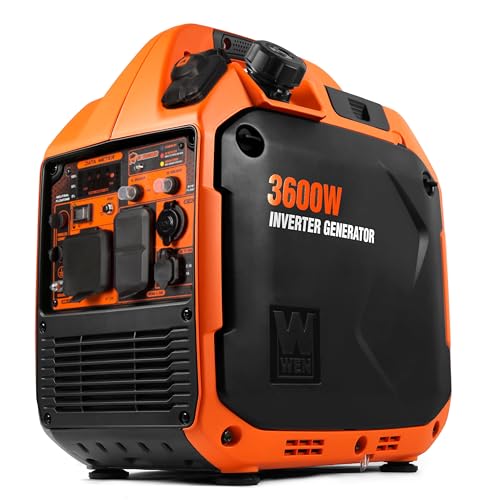
WEN 56250i
Best fit: Buyers wanting a light gasoline model with multiple small-device outlets and a fuel-shutoff feature for storage.
- Listing: 2,500 surge / 1,900 rated watts
- 37.5-pound listed weight
- Two 120V receptacles, two USB ports, hour meter, fuel shutoff, and three-year warranty are listed
The listing describes clean power for sensitive electronics, but your CPAP manual still determines compatibility. A built-in USB port is not a substitute for the CPAP’s approved power supply.
View WEN 56250i on Amazon →
A-iPower 2300-Watt Dual Fuel
Best fit: An emergency kit that values gasoline-or-propane flexibility and a 30-amp locking receptacle.
- Gasoline listing: 2,300 starting / 1,800 running watts
- Propane listing: 2,000 starting / 1,600 running watts
- CO sensor, less than 3% THD, USB, household duplex, and L5-30R outlets are listed
Size the plan from the lower propane rating when propane is the intended fuel. The listing’s noise claim is as low as 61 dB; test conditions matter.
View A-iPower 2300W on Amazon →You can compare more small models in our 2,000-watt inverter generator category. If the same outage plan includes cold food storage, calculate that motor load with our refrigerator generator guide rather than assuming the CPAP is the largest load.
Safe setup for home outages
- Charge and test before an emergency. Confirm the bedside battery can complete a normal night with your real settings and accessories, leaving reserve.
- Choose the outdoor generator location in advance. It must be at least 20 feet from homes and other buildings, with exhaust directed away from all windows, doors, vents, tents, and RV openings.
- Use working CO alarms. Install battery-operated or battery-backup alarms on every level and outside sleeping areas, following local guidance and alarm instructions.
- Keep the generator and connections dry. Follow the manual’s wet-weather instructions without enclosing the generator or restricting ventilation.
- Recharge while awake. Monitor the generator and battery charger. Shut down and cool the generator before refueling.
- Never backfeed. Do not connect a generator to a wall receptacle. A home-circuit connection requires approved transfer equipment installed by a qualified electrician.
Read our CO shutoff generator guide before relying on any sensor feature, and keep the unit ready with the schedule in our generator maintenance guide.
CPAP camping considerations
A campground may prohibit generators overnight or limit them to set hours. Even where operation is allowed, generator noise and exhaust can affect nearby campers. A properly sized battery avoids both problems at bedtime. Recharge it during designated hours, then store the cooled generator and fuel according to campground and manufacturer rules.
Do not place a generator in a tent vestibule, under an RV awning, beneath a slide-out, inside a truck bed with a cover, or in any partly enclosed space. Plan cable length and weather protection without moving the generator closer to occupied areas. For more campsite-specific selection factors, see our quiet camping generator guide.
Frequently asked questions
Will a 2,000-watt inverter generator run a CPAP?
For wattage alone, most 2,000-watt-class generators have far more output than a CPAP requires. Compatibility, safe placement, overnight noise, fuel, and continuity matter more. A bedside battery plus outdoor daytime generator is generally the more practical arrangement.
Can I plug a CPAP directly into an inverter generator?
Only if the CPAP and generator manuals allow it, the power specification is compatible, and the generator is safely located outdoors. Direct connection also means therapy stops if the generator runs out of fuel, trips, or is shut down. It does not solve overnight CO and noise concerns, so a compatible battery buffer is preferable.
How large a battery do I need for eight hours?
Measure or obtain the exact machine’s demand in its normal configuration, multiply average watts by hours, then account for conversion losses and reserve. Humidification, heated tubing, pressure, and battery temperature can materially change runtime. Use the CPAP manufacturer’s battery guidance and test the complete setup before depending on it.
Is clean inverter power safe for every CPAP?
No generator label can establish compatibility with every medical device. The models above make clean-power or low-THD claims, but the CPAP manufacturer’s input requirements and approved accessories control. Ask the equipment provider when the documentation is unclear.
Can I run the generator all night if it is 20 feet away?
Twenty feet outdoors with exhaust away from openings is the CPSC’s minimum placement guidance, not permission to ignore the manual, weather, noise rules, fueling, theft, fire risk, or the need to monitor equipment. A charged bedside battery removes the need for overnight generator operation in many plans.
Does a CO shutoff make a generator safe near an RV or tent?
No. CO shutoff systems are backups that may reduce risk in some conditions; they do not make exhaust safe. Keep the generator far from occupied spaces and direct exhaust away from every opening.
Bottom line
The best portable inverter generator for CPAP preparedness is not necessarily the largest model. A compact 1,800- to 1,900-running-watt unit can easily support most battery chargers while leaving capacity for selected essentials. The Honda emphasizes low listed noise and support, the Champion and WEN emphasize portability, and the A-iPower adds dual-fuel flexibility. Build the system around a CPAP-compatible bedside battery, verify runtime with your exact therapy setup, and use the generator outdoors as a supervised recharging layer.