
Quick answer: A remote start portable inverter generator is worth considering when you regularly use backup power, have limited mobility, operate an RV, or want to start and stop an outdoor generator without repeatedly walking to it. The feature does not turn a portable generator into an automatic standby system. You still need to place and inspect the generator outdoors, confirm the area is clear, manage connected loads, maintain the starter battery, and follow the exact startup sequence in the owner’s manual.
Remote does not mean unattended: Before every start, verify that the generator is outdoors in a dry, ventilated operating location, the exhaust points away from buildings, fuel and oil are ready, cords are undamaged, and no unexpected load will energize. The CPSC advises operating portable generators outdoors at least 20 feet from homes and buildings, with exhaust directed away from windows, doors, and vents.
Affiliate disclosure: Generator Square may earn a commission from qualifying Amazon purchases made through links on this page, at no additional cost to you. Product specifications below come from current manufacturer or retailer listings and manuals. We do not claim hands-on testing.
What remote start actually does
Most remote start portable generators use a battery-powered key fob to send a start or stop command to a receiver on the generator. A factory system normally coordinates the electric starter and automatic choke, so the engine can start without someone pulling a recoil cord or adjusting the choke at the control panel. The generator still needs its battery switch, fuel valve, or standby control set as the manual requires.
Remote start is different from three features shoppers often confuse with it:
- Electric start means a button or key on the generator operates the starter motor. It may not include a wireless remote.
- Automatic standby power uses permanently installed equipment that senses an outage and starts without a person issuing a command. A portable generator with a key fob is not automatically a standby generator.
- Two-wire or ATS start is a control interface used by certain transfer equipment, inverters, or energy systems. A wireless remote does not prove that a generator supports two-wire start or a particular automatic transfer switch.
If automatic operation is part of your plan, verify the generator’s exact control interface and transfer equipment with the manufacturers and a licensed electrician. Do not assume that a remote key fob can be modified safely into an automatic-start input.
When remote start is worth paying for
Home outage routines
After you have placed and connected a portable generator correctly, remote stop can save repeated trips outside when loads are no longer needed. Remote start may also be convenient during a continuing outage, but only after the generator has been inspected before that run. For household circuits, use approved transfer equipment installed for the generator and local requirements; never feed power through a wall receptacle. Our guide to powering a house with a portable inverter generator explains the planning limits.
RV and campsite use
A key fob can be useful when the generator is positioned at a safe, permitted distance and the operator wants to stop it without leaving the RV. Campground rules, quiet hours, fire restrictions, exhaust direction, and neighboring sites still control whether operation is appropriate. A long advertised remote range is not permission to operate the generator where you cannot monitor it.
Mobility and accessibility
Remote start can reduce bending, pulling, and walking on uneven ground. It does not eliminate setup tasks such as fueling, checking oil, moving the generator, connecting cords, and inspecting the operating area. Compare dry weight, wheel design, handle height, battery access, and control labeling as carefully as the remote feature.
Frequent short operating sessions
People charging an RV battery bank or running scheduled equipment may value convenient stop and restart control. However, repeated short runs can be poor for maintenance readiness if the battery is neglected or the engine never reaches the conditions recommended by its manual. Follow the manufacturer’s exercise and storage instructions rather than inventing a schedule around the remote.
Remote start features to compare
| Feature | Why it matters | What to verify |
|---|---|---|
| Rated and starting watts | Determines which loads the generator can support | Separate ratings for gasoline, propane, and natural gas |
| Remote range | Affects convenience through walls and at a campsite | Manufacturer test conditions; buildings and weak batteries can reduce range |
| Backup starting method | Keeps the generator usable if the remote or starter battery fails | Recoil starter, local push button, and battery charging provisions |
| CO shutoff | Adds a safety layer when dangerous CO accumulates near the unit | It never makes indoor or near-building operation safe |
| Outlets and transfer readiness | Must match the RV, cord, inlet, or transfer plan | Voltage, amperage, receptacle type, neutral configuration, and approved equipment |
Start with the load calculation, not the remote range. Use our inverter generator wattage guide to total continuous loads and the largest realistic motor-starting event.
Four remote start inverter generators to compare
These four products currently have enabled U.S. Amazon offers in the store data and cover different output levels. We omit prices, ratings, and review counts because they change. Check the current listing and owner’s manual before ordering.
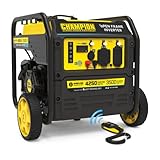
Champion 4250-Watt Wireless Remote Start Inverter
Best fit: RV, project, or backup shoppers who want useful midrange output and do not require dual-fuel operation.
- Listing: 4,250 starting / 3,500 running watts
- Wireless start and stop from up to 80 feet are listed
- 64 dBA, Economy Mode, TT-30R RV outlet, and parallel capability are listed
This is an open-frame inverter design. Compare sound, enclosure, and fuel requirements with closed-frame models.
View Champion 4250W on Amazon →
Westinghouse iGen5000c
Best fit: A gasoline-powered, enclosed inverter for an RV or selected home essentials where a TT-30R outlet is useful.
- Listing: 5,000 peak / 3,900 rated watts at less than 3% THD
- Remote key fob, electric start, and recoil start are listed
- As low as 52 dBA, CO shutdown, digital data center, and parallel capability are listed
The owner’s manual states remote starting can work from up to 99 feet under its conditions; battery state and obstructions affect real range.
View Westinghouse iGen5000c on Amazon →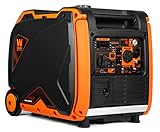
WEN DF452iX Dual Fuel Inverter
Best fit: Buyers wanting midrange remote-start convenience with gasoline or propane flexibility.
- Gasoline listing: 4,500 surge / 3,500 rated watts
- Propane listing: 4,500 surge / 3,150 rated watts
- Remote operation up to 160 feet, 58 dBA at quarter load, CO Watchdog, TT-30R, and recoil backup are listed
Always size from the lower propane running rating if propane is your intended outage fuel.
View WEN DF452iX on Amazon →
DuroMax XP9500iH Dual Fuel Inverter
Best fit: Higher-output home backup, RV, or jobsite plans that genuinely need the capacity and appropriate connection equipment.
- Listing: 9,500 peak / 7,600 running watts
- Gasoline or propane operation, remote control, and CO Alert are listed
- 50-amp outlet, ATS outlet, battery tender, and parallel capability are listed
High output adds weight, fuel demand, and connection complexity. Confirm the load calculation and transfer equipment before choosing this class.
View DuroMax XP9500iH on Amazon →See the complete remote start inverter generator category. If fuel flexibility matters more than a key fob, compare our dual-fuel inverter generator guide. Higher-output options are also organized in the 5,000-watt and larger category.
A safe remote-start preflight checklist
- Inspect the location in person. Confirm the generator is outdoors at least 20 feet from buildings, exhaust faces away, and no door, window, vent, neighboring structure, dry vegetation, or stored fuel is in the exhaust or heat path.
- Check weather protection. Keep the generator and connections dry using a manufacturer-approved outdoor arrangement that does not trap exhaust or create an enclosure.
- Check oil, fuel, and leaks. Never refuel a hot or running generator. Confirm fuel valves and switches are set exactly as the manual requires.
- Inspect cords and transfer equipment. Use outdoor-rated cords with adequate wire size, or approved transfer equipment installed by a qualified electrician. Never backfeed a receptacle.
- Manage the load. Unless the manual and installed equipment specify otherwise, avoid starting the engine under a large connected load. Add loads in stages and preserve surge headroom.
- Confirm CO alarms work. Use battery-operated or battery-backup CO alarms on every level and outside sleeping areas. A generator-mounted CO shutoff is an additional layer, not a substitute.
- Remain available to monitor operation. Watch for overloads, leaks, abnormal sound, exhaust changes, weather, and unauthorized access.
Battery and remote maintenance
Remote start depends on two batteries: the small battery in the key fob and the starter battery on the generator. A generator can have fresh fuel and still fail to crank after months of storage. Follow the manual for charging, battery-tender use, terminal inspection, storage, and replacement. Keep the recoil-start procedure accessible, but remember that some automatic-choke or fuel-control systems may still have model-specific battery requirements.
Store spare remote batteries in a suitable location, label each fob if you own more than one generator, and test remote start during scheduled readiness checks. Do not leave the generator staged indefinitely with old gasoline or without completing its storage procedure. Review our portable inverter generator maintenance guide before storm season.
Frequently asked questions
Can a remote start generator start automatically during an outage?
Not merely because it has a wireless key fob. Automatic outage response requires compatible sensing, start controls, transfer equipment, installation, and approvals. Treat a portable remote-start generator as manually commanded unless its exact documentation and installed system explicitly state otherwise.
How far away does generator remote start work?
It depends on the model and conditions. The products above list ranges from about 80 to 160 feet where specified. Walls, terrain, interference, orientation, and weak fob or starter batteries can reduce usable distance. More range does not make unattended operation safe.
Can I remote-start a generator connected to my RV?
Only if the generator, RV connection, load state, campsite rules, and manuals support the procedure. Inspect the generator location first, direct exhaust away from every occupied area, confirm the cord and outlet ratings, and avoid energizing a heavy load unexpectedly.
Is remote start the same as electric start?
No. Remote start sends a wireless command; electric start operates the starter locally. Many remote-start generators include electric and recoil backup, but an electric-start label alone does not promise a remote.
Should I add an aftermarket remote-start kit?
A factory-integrated system is easier to verify against the generator’s choke, ignition, safety interlocks, and warranty. Do not bypass safety devices or improvise automatic control. Before any modification, get written compatibility guidance from the generator and kit manufacturers and use a qualified technician where required.
Bottom line
Remote start is a convenience feature, not a reason to overlook wattage, fuel, sound, weight, outlets, CO protection, maintenance, or safe placement. For a midrange RV or essentials plan, the Champion 4250W, Westinghouse iGen5000c, and WEN DF452iX represent distinct gasoline, enclosed, and dual-fuel choices. The DuroMax XP9500iH belongs in a higher-output plan with a verified need and appropriate connection equipment. Choose the generator first by load and safe installation; use remote start only after the preflight checks are complete.


